From the Perspective of a Claimant who ‘lived to tell the tale’.
If you are wondering if HSDC did apologise for the appalling way I was treated; yes they did. At the end of the Liability Hearing, their legal counsel/barrister delivered the following ‘below the belt’ apology:
‘The respondent is sorry to lose the claimant as an English teacher, though not the best!’
How did we get here…?
‘The best way to eat an elephant in your path, is to cut it up into little pieces‘ – African proverb.
When you embark on this journey, be prepared to lose on a number of your claims for the following reasons:
The respondent (the employer) will most likely be legally represented while you are more likely to be a litigant in person (unrepresented). In instances where it is your word against theirs; it’s going to be difficult to convince the judge that the respondent isn’t credible. Senior staff will close ranks, attempt to justify their actions and/or refuse to answer questions.
If you are not represented you will struggle to contain your emotions enough to be logical and coherent (dealing with correspondence from/to the tribunal and the respondent’s legal representative and appearing at hearings).
After submitting your ET1, the respondent may make an application for ‘further and better particulars’. Don’t panic, this means you are being asked to provide additional information. Sometimes this is done as an intimidation tactic – so take a deep breath and give them the additional information they have requested, otherwise your claim might get struck off!
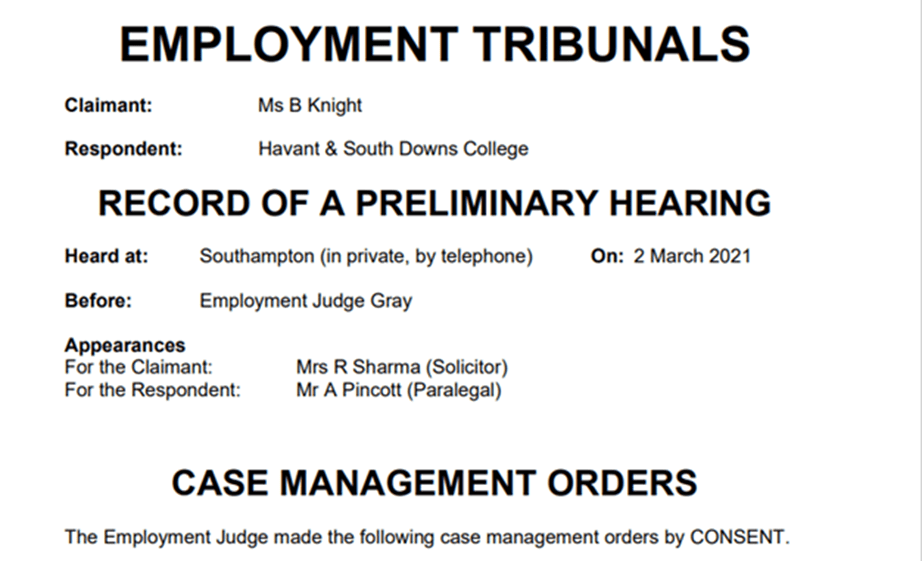
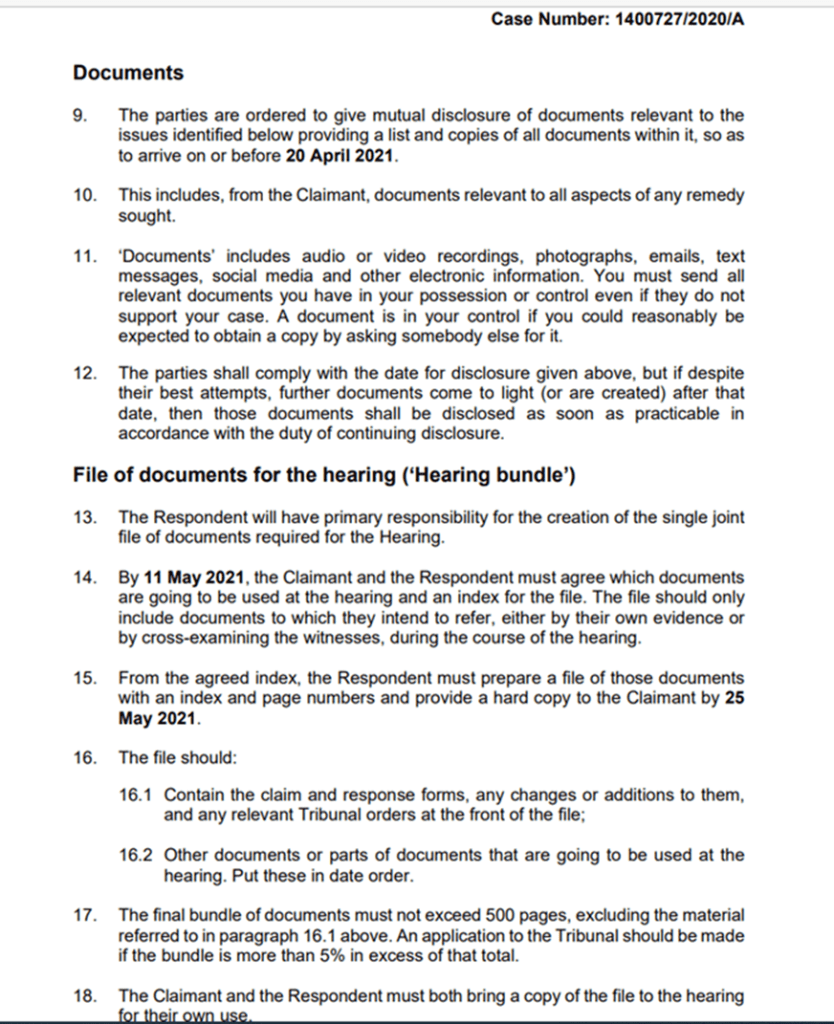
Ignoring Case Management Orders (CMO) – If your claim is accepted and the other party has submitted their grounds of resistance (their defence), your case will be listed for a Preliminary/Case Management Hearing. At this hearing, the judge will issue Case Management Orders/directions which are legally binding Don’t ignore case management orders – even if the respondent ignores them. It suits the respondent (some respondents seem to thrive on chaos) – they will bring in an experienced barrister to the final hearing who will be able to improvise with limited preparation.
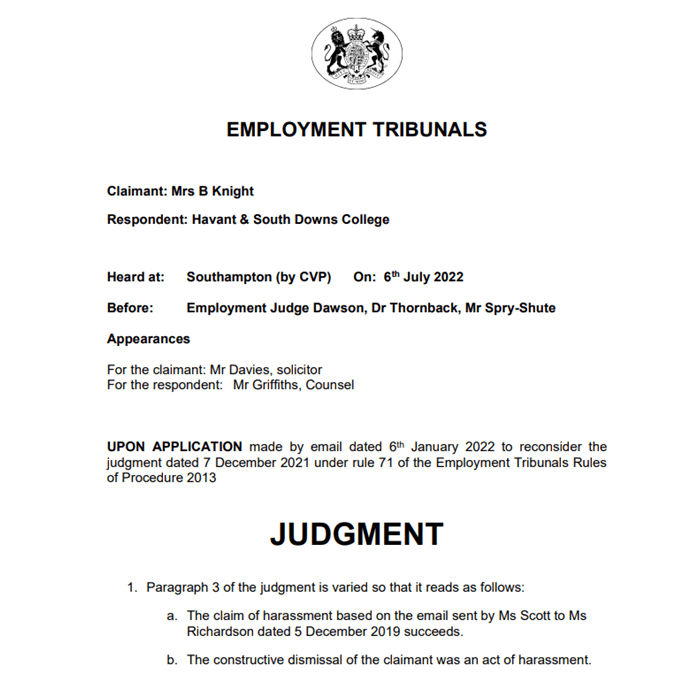
See example 1 below where both parties ignored the case management orders – and the claimant was put at a disadvantage.
The respondent fails to comply with disclosure orders – most don’t. If this happens, send a ‘gentle’ reminder, and cite the ‘overriding objective’ and if after at least two or three reminders they still refuse to comply, write to the Tribunal.
See example 2 below
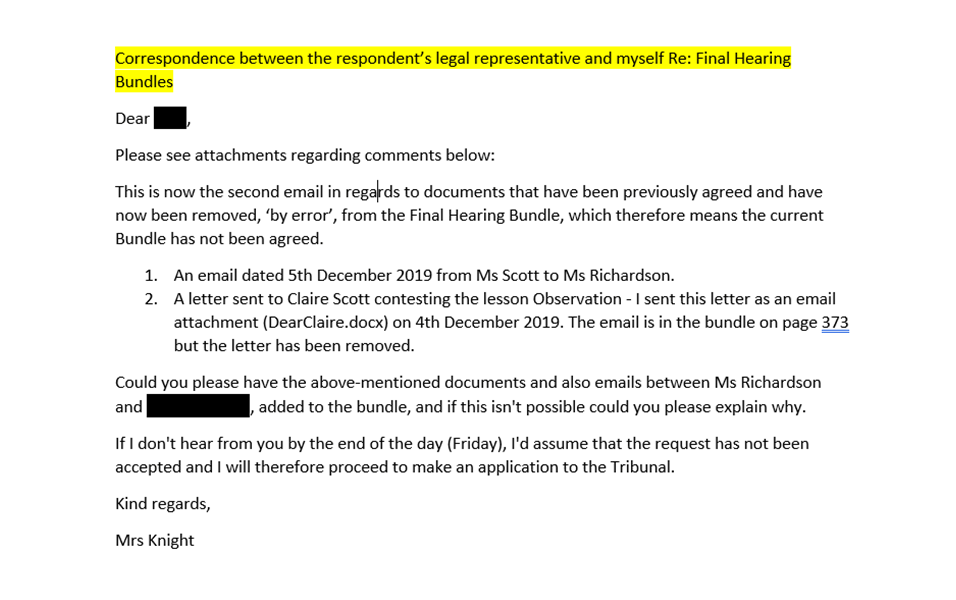
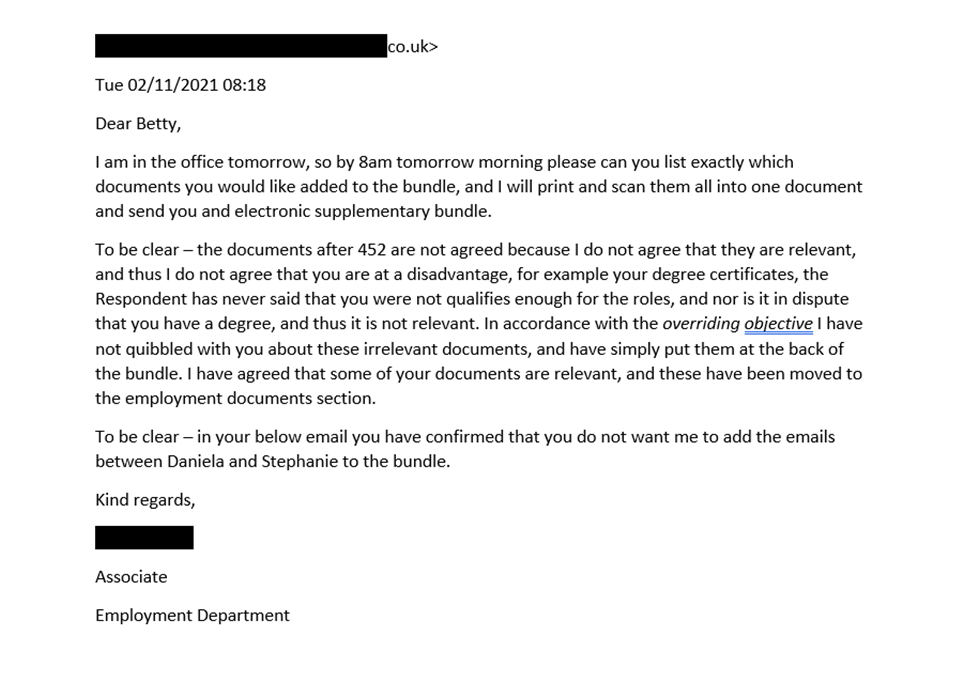
The respondent is responsible for compiling the draft bundle and the final hearing bundle. Go through both bundles with a fine-tooth comb before agreeing it. If they send it off to the tribunal without it being agreed by both parties, don’t delay, quickly notify the tribunal by email that the final draft bundle was not agreed.
The respondent’s legal representative will attempt to remove some of your most significant documentary evidence from the Final Hearing Bundle, as they deem the documents not relevant to the list of issues. They aren’t doing this to be ‘nice’ to you – in fact they have just highlighted the most important evidence in your case – fight to have it included in the final hearing bundle.
See example 3 below
Lastly, potential key witnesses might stay quiet, be unwilling (best avoided) or disappear at the last minute. Be careful about putting too much emphasis on a witness and their statement, because the respondent will be well versed in disrupting and devaluing witnesses’ evidence and support for a claimant.
SEE BELOW SOME EXAMPLES OF ET CORRESPONDCE/COMMUNICATION I WROTE AS A LITIGANT IN PERSON…
- An excerpt from an ET Written Judgement detailing what happens when parties fail to comply with CMOs
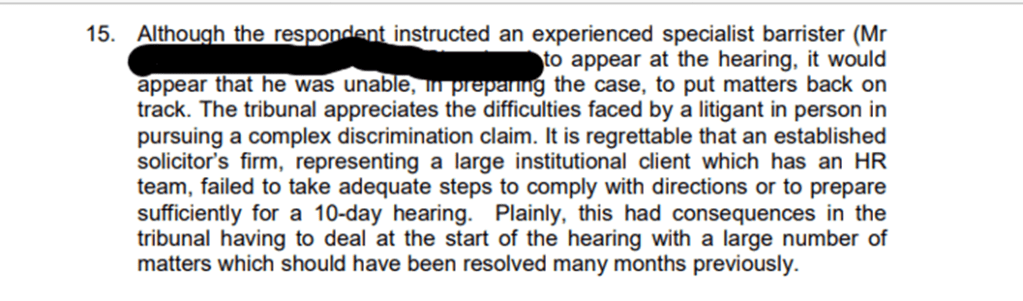
2. Example of an Application requesting a Disclosure Order – I wrote this as a Litigant in Person.
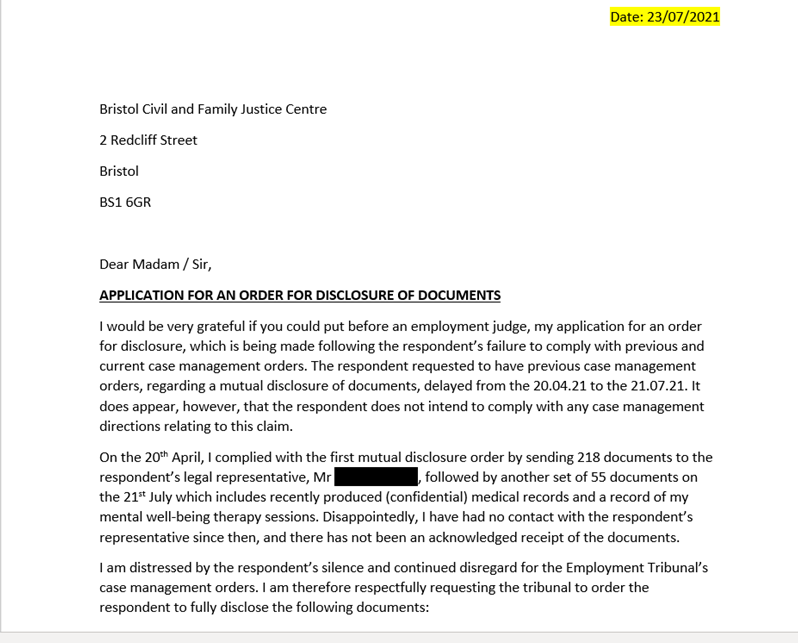
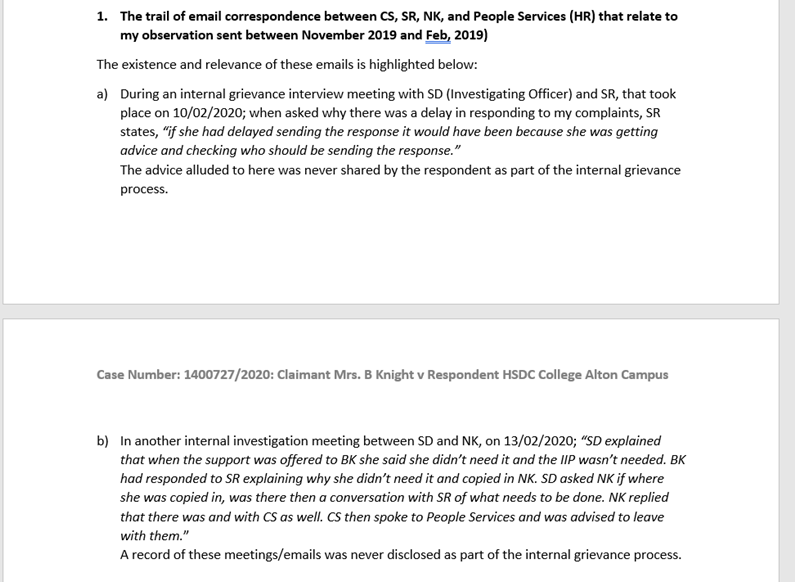
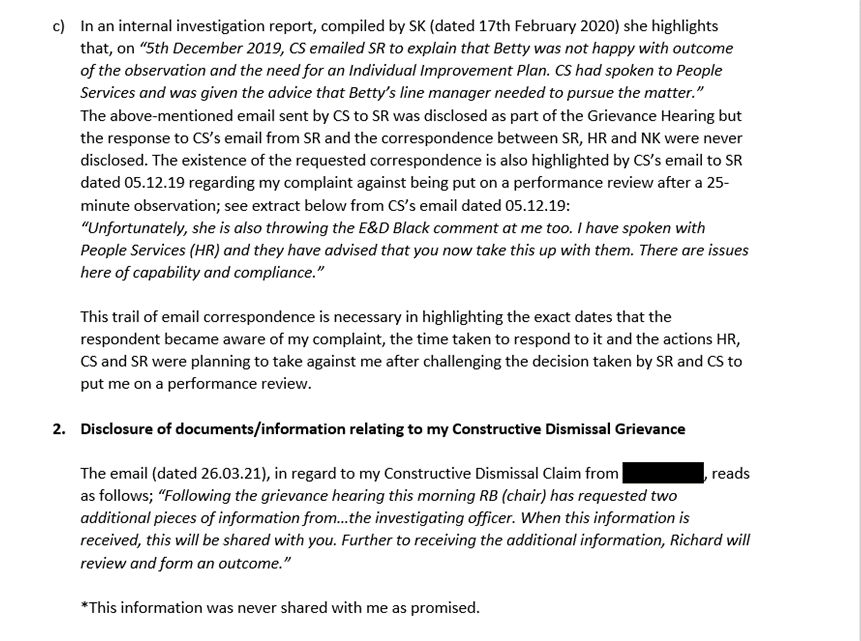
Application to Strike Out Respondent’s Response (sent to ET by myself (as Litigant in Person) when the respondent carried on ignoring Case Management Orders following the above Disclosure of Documents Order Application)
Dear Sir/Madam,
I would be very grateful if you could put before the Employment tribunal judge an application to strike out the respondent’s response on the following grounds.
Failure to Comply with Case Management Orders:
- Despite the Tribunal having made it clear (in the correspondence dated 02.03.21 – Record of A Preliminary Hearing) as to the consequences of failure to comply with Case Management Orders (page 5). The respondent continues to show a general disregard for ongoing legal proceedings. (See page 5; 30). This is also despite the fact that the case is currently listed for a further (third) Case Management Hearing which will be conducted by telephone on 06.10.21, specifically to ensure compliance with Case Management Orders.
- The respondent’s failure to comply with the very first Case Management Order (deadline 20th April), despite no variations to current orders having been issued or agreed, is very concerning. The Second Case Management Order (deadline 11.05.21) has now also been ignored, since the respondent still refuses to disclose documents in their possession that are relevant to claims made against them.
- The respondent is likely to plead that my current application to add a constructive dismissal claim to my existing claims, is the reason for their non-compliance. This claim, like all claims made against the respondent, has been subject to the respondent’s internal grievance process and as per procedure, the bundle relating to this claim was prepared before the Grievance Hearing scheduled for 26th March 2021.
Conduct of the respondent’s legal representative
- The respondent’s legal representative’s continued unwillingness to fulfil their duty under Rule 2 (of The Employment Tribunals Rules of Procedure) to enable Employment Tribunals to deal with cases fairly and justly. Evidenced in a string of emails sent to myself and the Tribunal (dated 8th April – 5th May 21).
Vexatious Response with No Reasonable Prospect of Success:
I consider the respondent’s current ET3 as a vexatious defence with no reasonable prospect of success because of the following reasons:
- The respondent’s current position is that they ‘deny all claims made against them’ and maintain the position that my claims are ‘misconceived and should be withdrawn’. The recent evidence, sent privately to the judge prior to the second Case Management Hearing before Judge Gray, highlights one of the many weaknesses in this line of defence – further weaknesses are highlighted by a list of documents disclosed to the respondent on the 19th April, 2021 (*This list will be sent separately to the judge with other evidence to be considered together with the application)
Additional factors:
- The two-year wait for justice continues to have a detrimental effect on our finances, family life and on my mental wellbeing which I fear might not be reversible. I also fear that if the respondent’s current unreasonable behaviour is allowed to go unchallenged, by the time this claim gets to be heard, they would have got rid of all staff members who are either directly named as alleged discriminators or are in possession of key documents that are relevant to claims being made against the respondent.
- Claire Scott left HSDC last year and Stephanie Richardson’s employment ends in July this year. These key members of staff are in possession of important emails regarding the decision for the joint observation and subsequent actions taken to put me on a performance review. I am therefore concerned that the current delay is yet another tactic to allow Stephanie to leave and later be used as an excuse as why certain important requested documents cannot be disclosed.
- Failure by the respondent to disclose correspondence between the abovementioned key members of staff, will put me at a disadvantage and inevitably lead to an unfair hearing.
- Mr. Myers and Ms Chapman were the two members of staff to witness the initial declarations of unfair treatment and discrimination, in 2017. With Vanessa and now Jon (Feb 2021) being forced to leave their employment it is evident the policy of removing anyone involved in this case is almost complete. Only Ms Kingsley, as a senior manager and Ms XX (who was never interviewed during the internal grievance process), remain as employees with obvious links to my case.
3. Example of correspondence between myself (LiP) and the Respondent’s Legal Rep regarding the Final Hearing Bundle.
Case Management Orders – What do they look like?
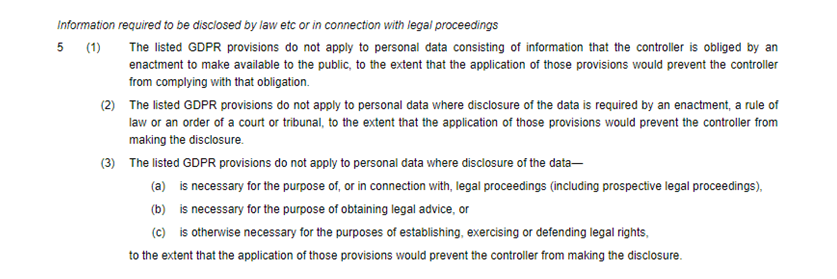
What are the rules in regard to GDPR and Legal Proceedings?
visit – https://www.legislation.gov.uk/ukpga/2018/12/contents/enacted
Justice: What does it look like?
The Judge ruled that my constructive unfair dismissal was ‘An Act of Harassment‘
Why was the 5th December, 2019 email viewed by the ET panel as an act of racial harassment?
READ EXCERPTS below (on this particular issue) taken from both written judgements:
34.
As already indicated, both parties accept that the act of harassment would only
occur when the claimant became aware of the email.
35.
We found, at paragraphs 144 to 145 of our judgment, that the email amounted
to conduct which was unwanted and that it related to the claimant’s race. It has
not been suggested that our findings were wrong in that respect and we remain
of those views. At paragraph 147 we concluded that had the claimant been
aware of the comments it would have had the effect of violating her dignity or
creating an intimidating, hostile, degrading, humiliating or offensive
environment for her.
36.
We now conclude that by 26 May 2020, at the latest, the claimant was aware
of the comments in the email. We consider that reading that email and realising
that a senior colleague had described her, to another colleague, as “throwing
the E & D Black comment at me too” would have, reasonably, had the effect of
creating an intimidating, hostile and offensive environment for her. The email
suggests that colleagues were talking about the claimant and suggesting that,
rather than believing she was advancing arguments in good faith, they were
asserting that she was simply “throwing” comments based on her own race at
her colleagues. On 4th December 2019 the claimant emailed to Ms Scott a letter with a series of 6 comments on the feedback. In essence she sought to defend herself
from the allegations. She stated that she felt the whole experience had been
very negative and degrading and the suggestion that she needed to enhance
her subject knowledge was disheartening (Page 401).
129.
In the feedback form, Ms Scott had recorded that she had seen no
promotion of equality and diversity. Within the document which the claimant
sent in reply she stated “As regards Equality and Diversity, I am a Black teacher
who is teaching English to a majority of White students. Is that not a challenge
to the racial stereotype and a positive role model to the one Black student in
the class? Yet, it appears my presence and efforts (it’s exhausting to have to
keep fighting for equality!) are being seen by you as making a completely
‘insufficient impact on learning’!! An area for development?”
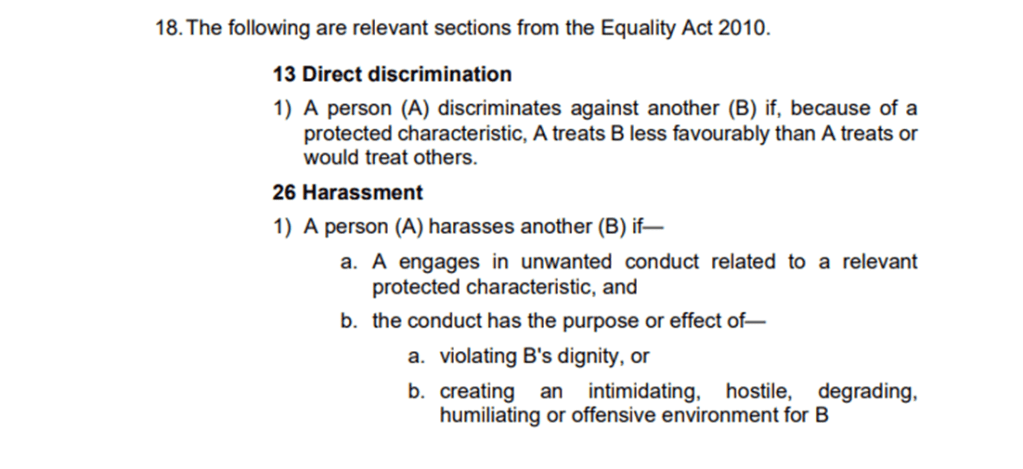
The Law: Discrimination
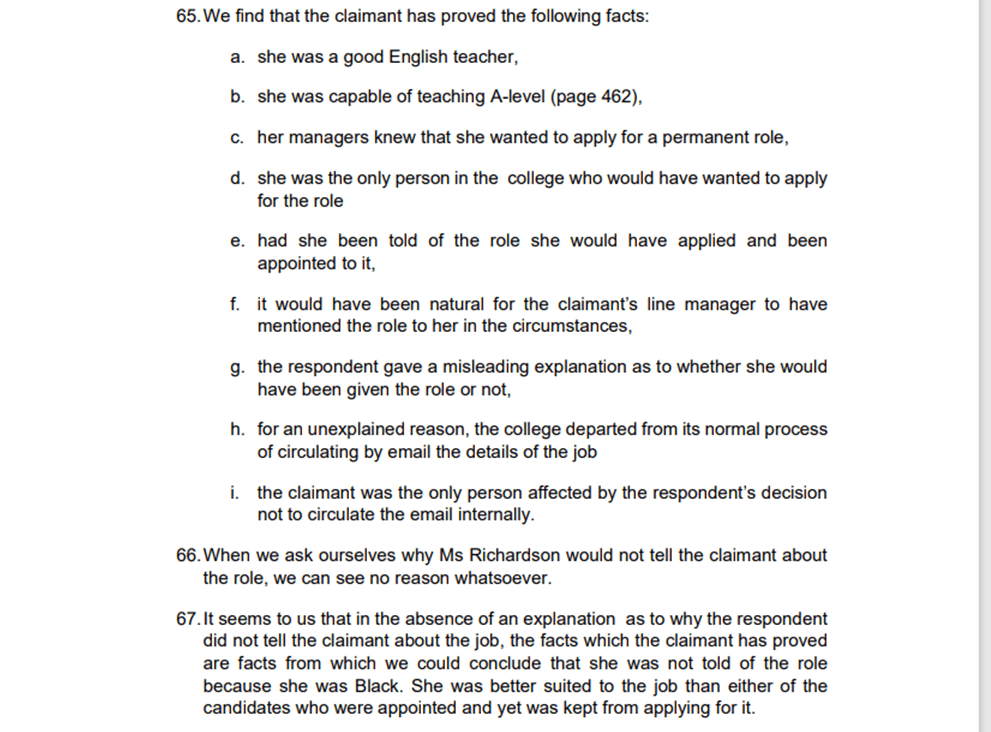
The Judgement: The ET’s Findings of Fact
 Iam!
Iam! 
Leave a comment